
Disclosure: This post may contain affiliate links, which means I may earn a commission if you click on the link and make a purchase.
If you adore pie, this post will help you to success! This step-by-step guide for homemade pie crust will result in an all-butter, flakey pie crust that’s easy to execute and perfect for Homemade Apple Pie, Rose Apple Pie or Apple Hand Pies.
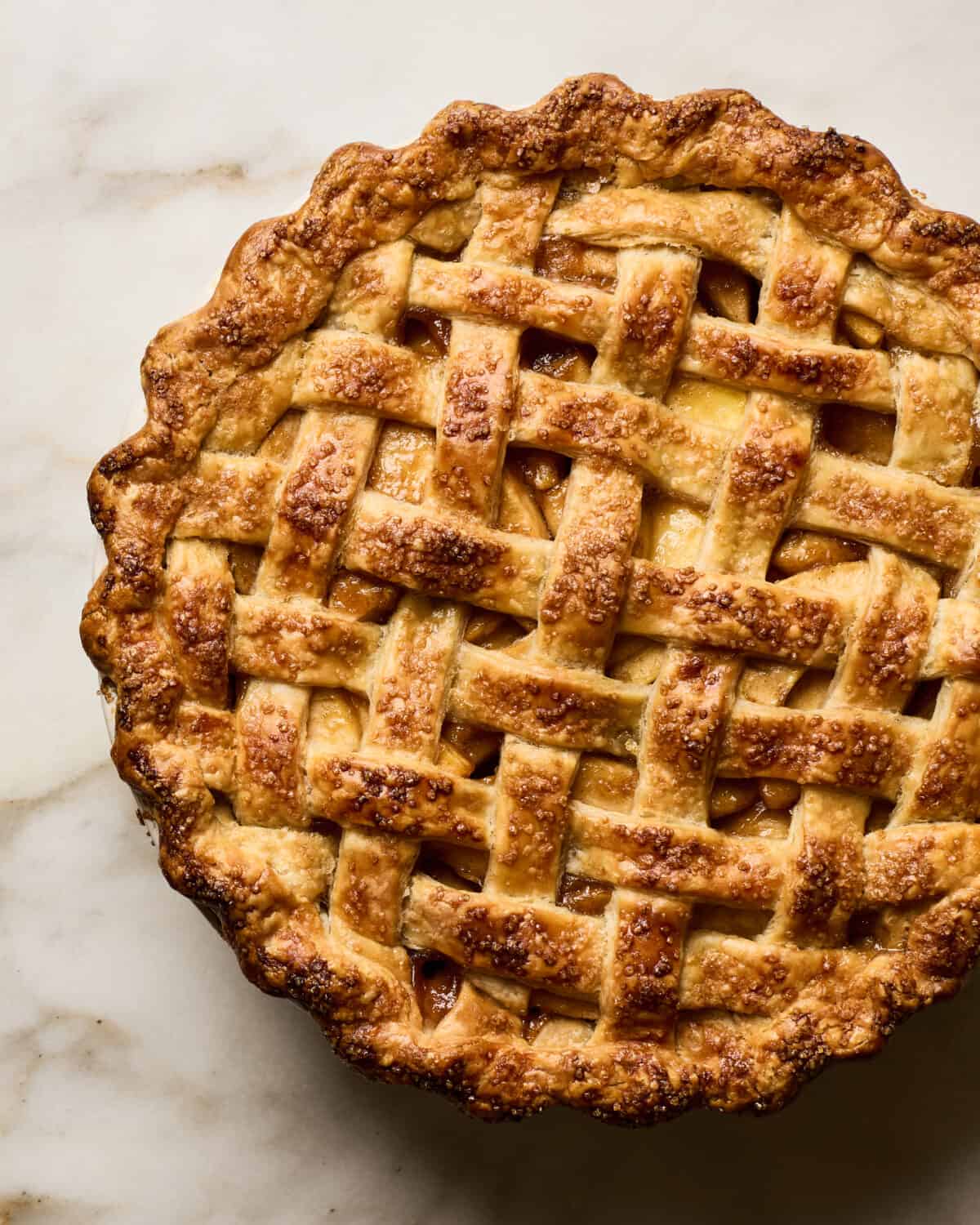
Pie is my love language. I’ll admit that the first time I made pie, years ago, it was a complete disaster. I blame myself for being a terrible reader of instructions AND pies aren’t “easy as pie.” (That might be the most inaccurate, idiotic idiom I’ve ever heard.)
Pie has its challenges, though it’s definitely not impossible. Hopefully these tips and photos will help make you successful at da pie-a-makin’. Use this pie crust for my favorite pies like my Classic Cherry Pie, Butter Pecan Pie, Black Bottom Pecan Pie or this Chocolate Coconut Pecan Pie.
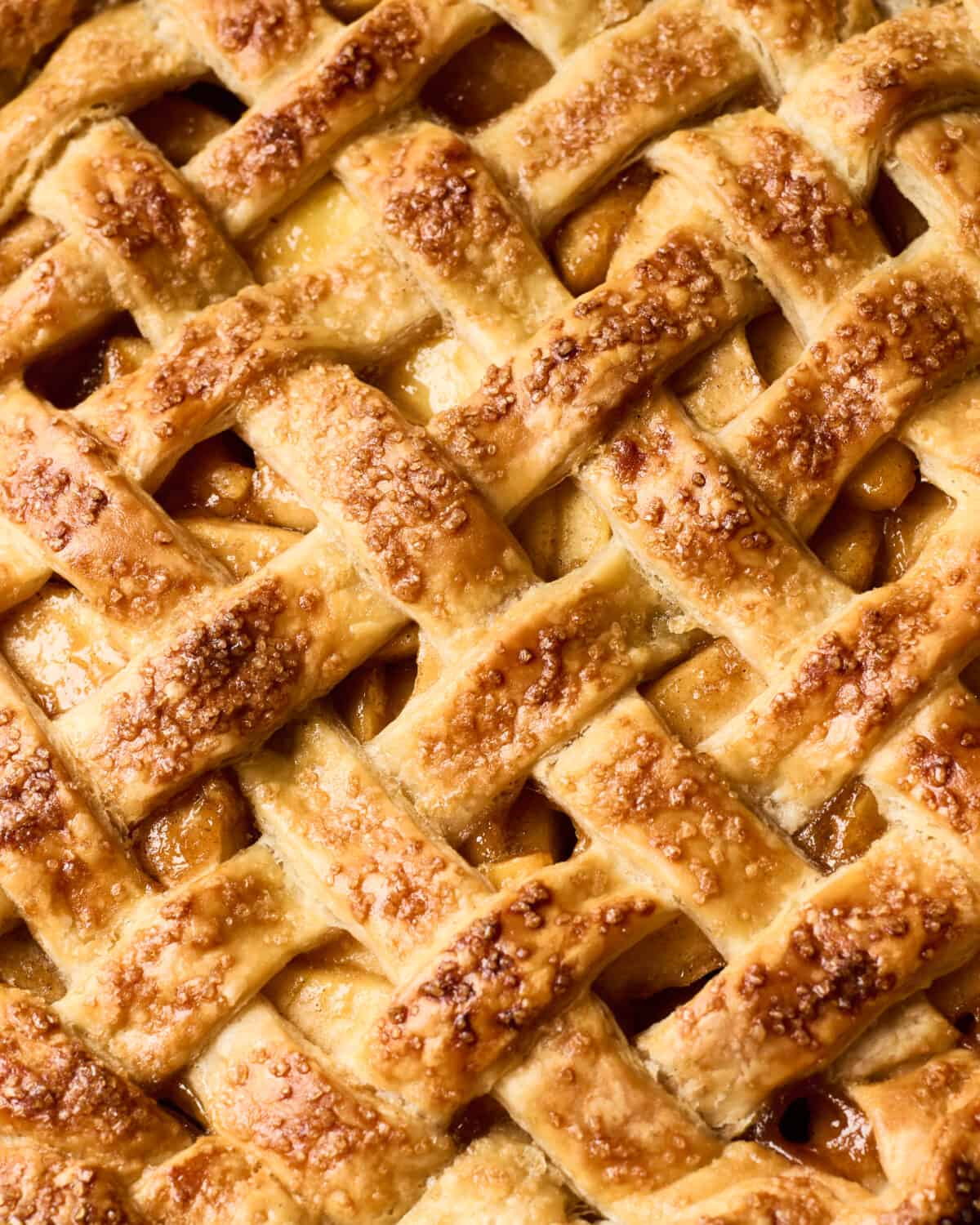
Ingredients You’ll Need for Homemade Pie Crust
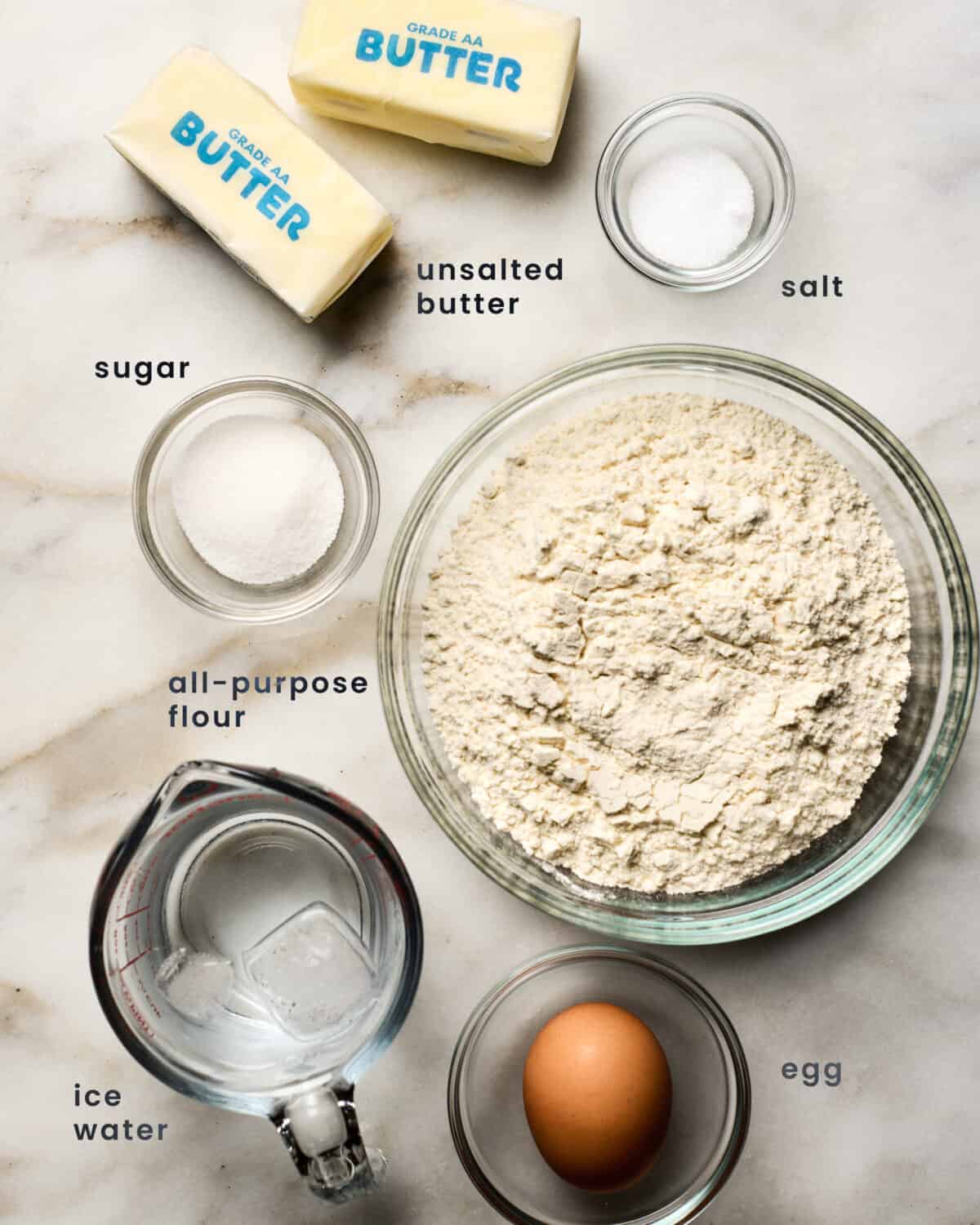
- All-purpose Flour – My favorite flour is King Arthur’s Flour. This unbleached, sturdy, high-quality flour results in the best pie crust results.
- Unsalted Butter – If you want to be fancy, feel free to use a European butter but I simply use American, grocery store-bought butter and I get great results.
- Ice Water – We want everything to be cold, including the water we’re adding to the pie crust.
- Sugar – This will give just the perfect amount of sugar for this pie crust.
- Salt – I like using kosher salt. Everything sweet needs a balance of salt.
For the rest of the ingredients and instructions, please see the recipe card below!
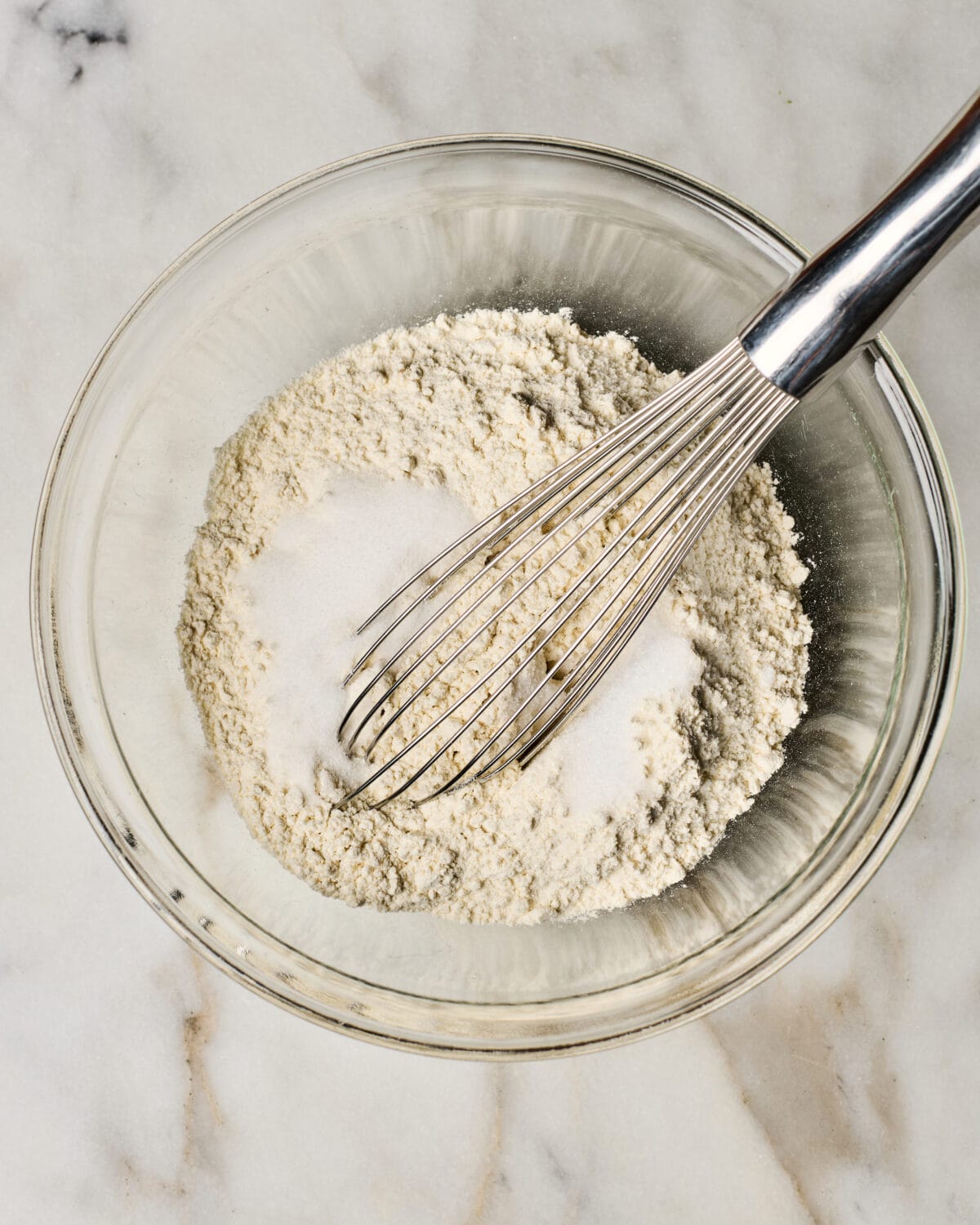
How to Make Homemade Pie Crust
- Mix together the dry ingredients. To a large bowl, add the flour, salt and sugar.
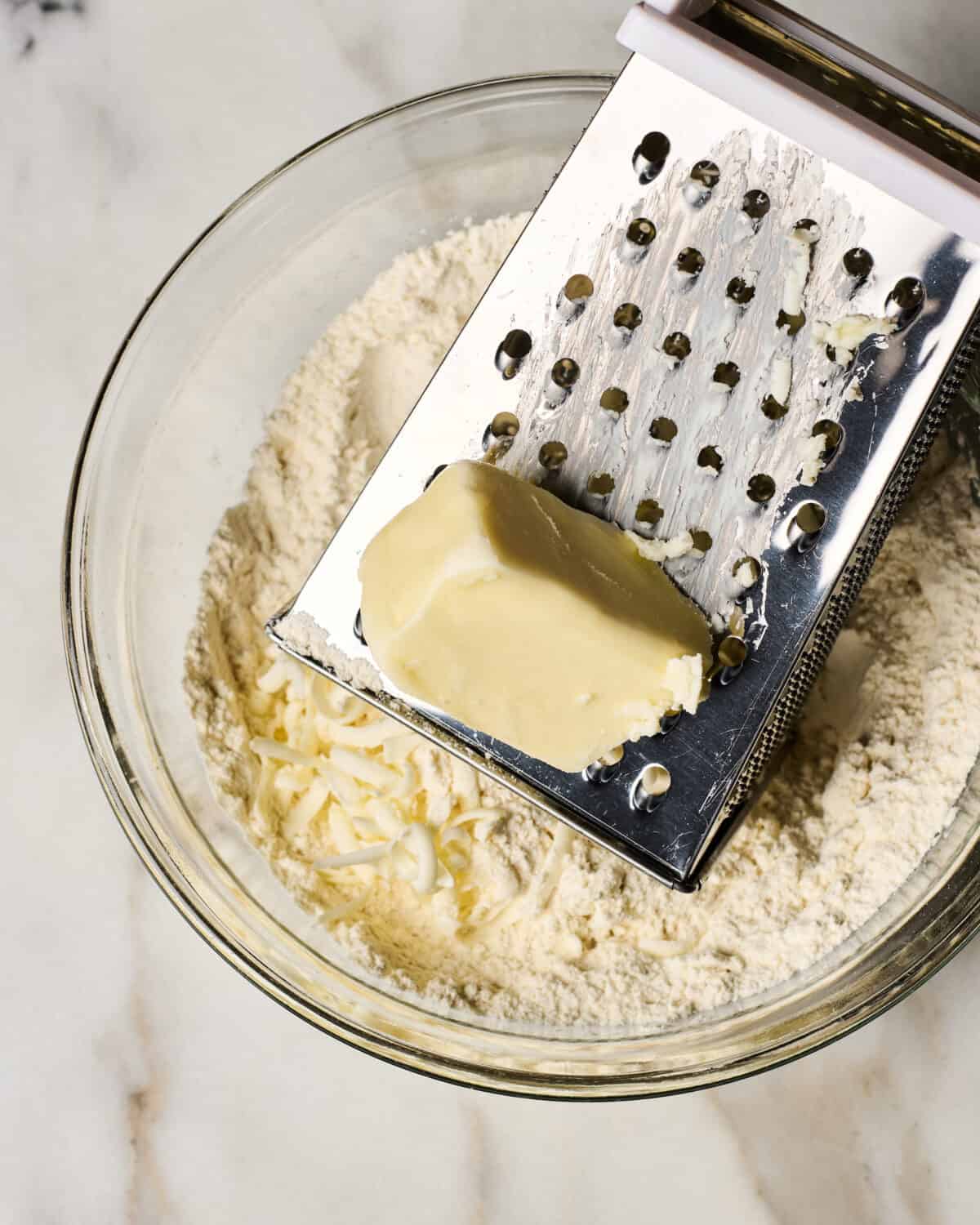
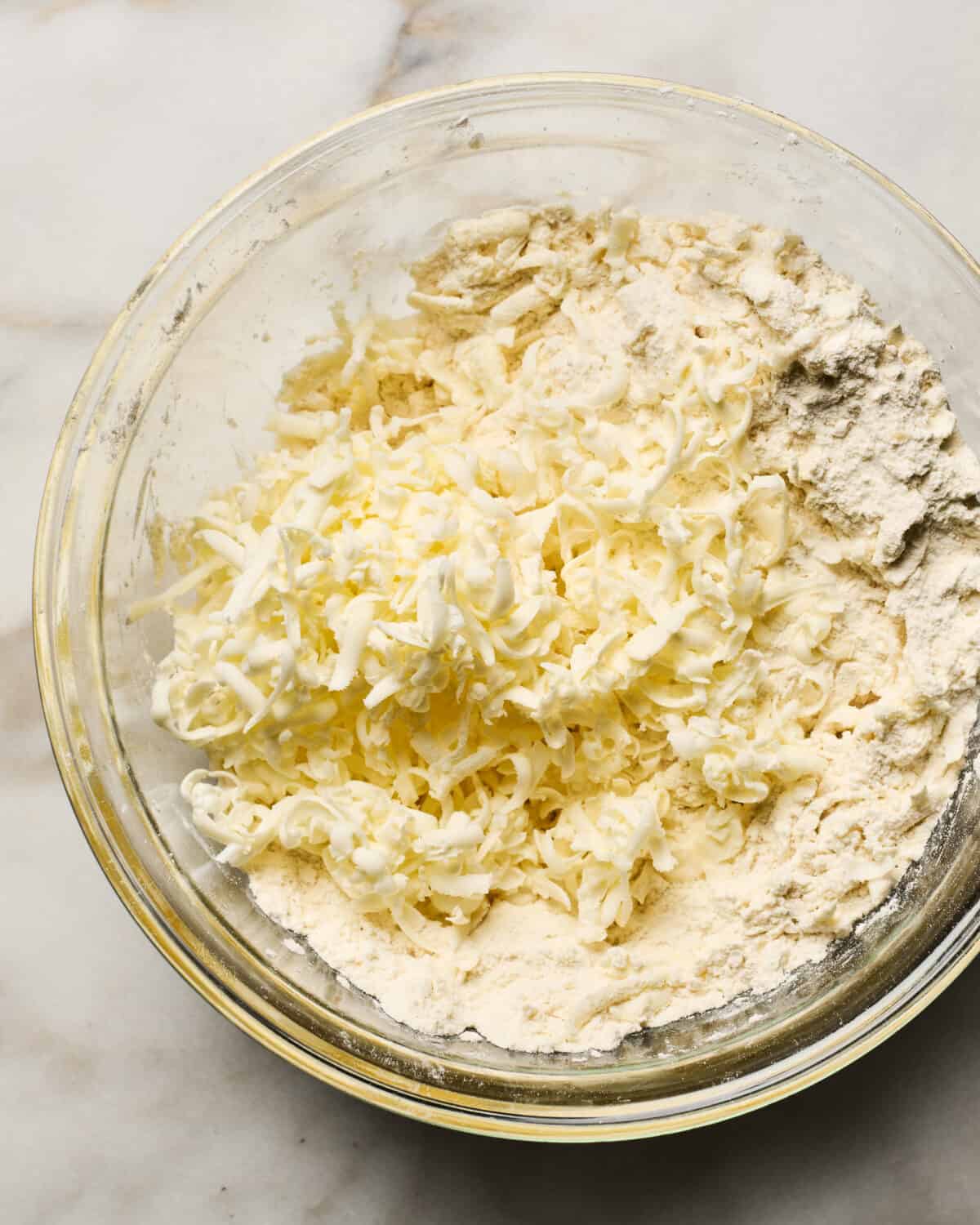
2. Use a box grater to cut up the butter. I find this WAY easier than breaking it up using a pastry cutter. Shred the butter atop the flour. The end goal when making pie dough is to get the butter to resemble pea-sized bits. This makes it so you handle the flour mixture less, which will result in a tender pie crust.
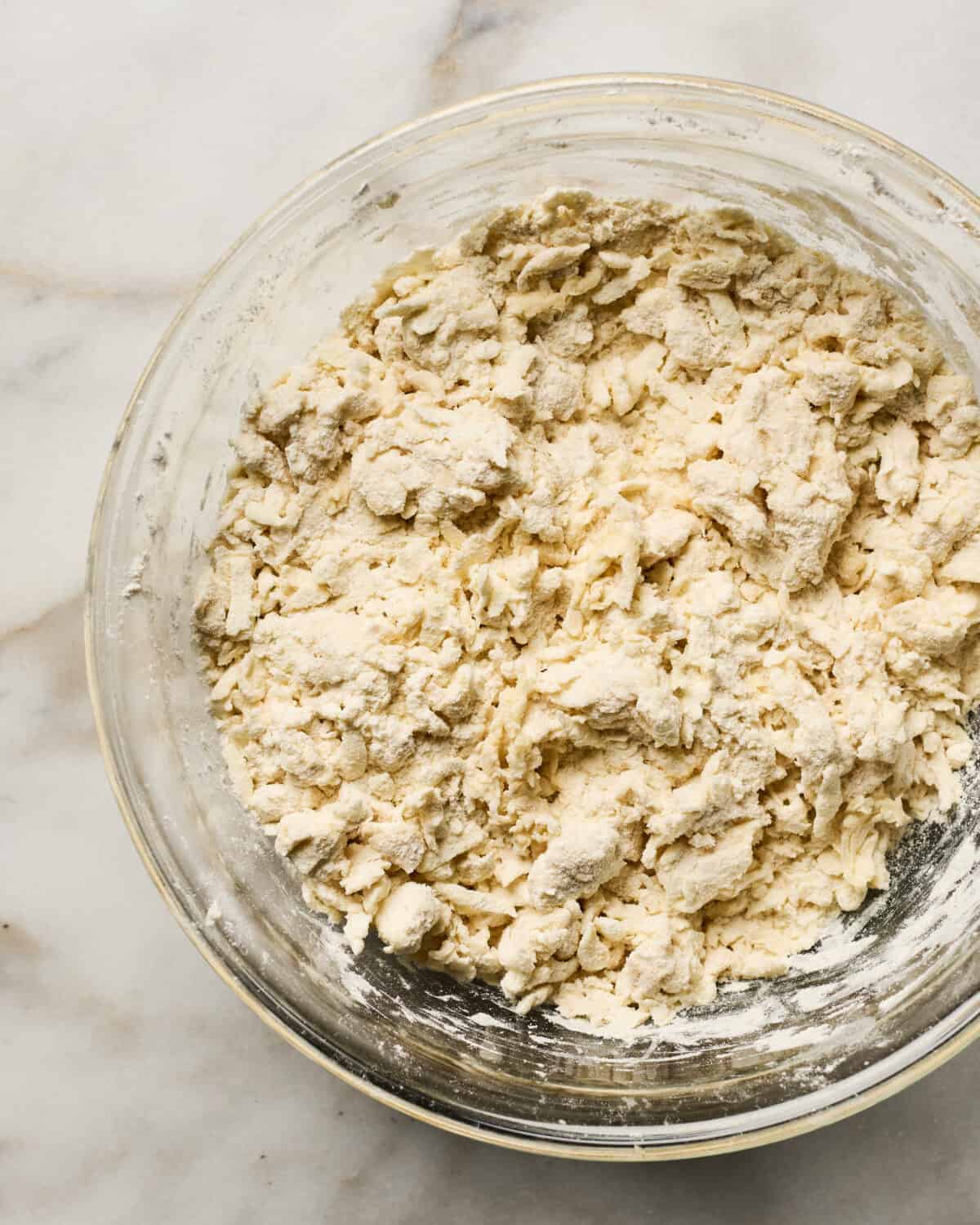
3. Stick the bowl in the freezer for 10 minutes. I like to do this because it gets the butter super cold. Next, press it with your fingers into the flour mixture. The color should go from white to slightly off-white/yellow. This means that it’s thoroughly mixed into the flour.
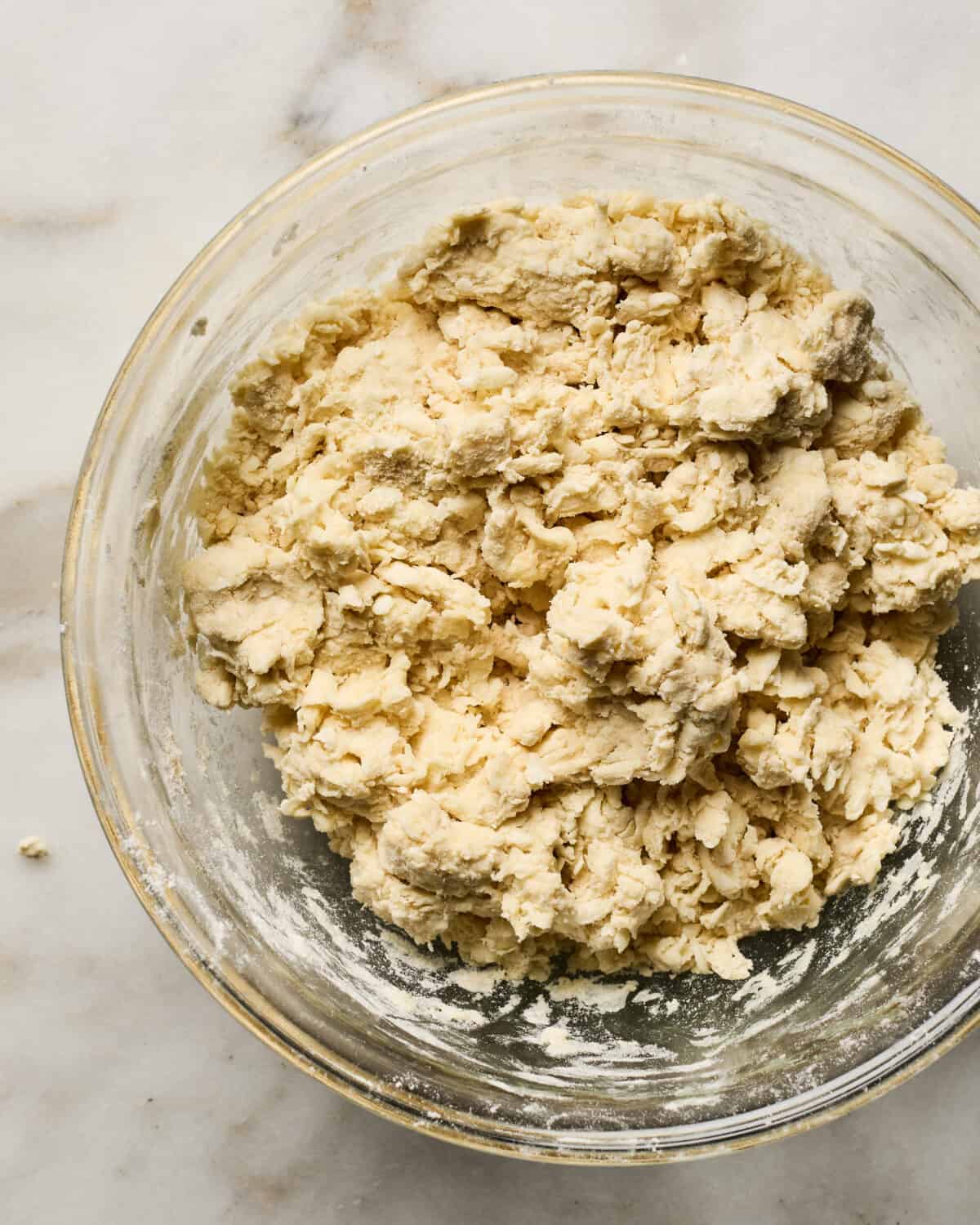
4. Pour in the water. I like to add about 50% of the water I need. Mix it together and then add more water a tablespoon at a time, until the dough comes together.
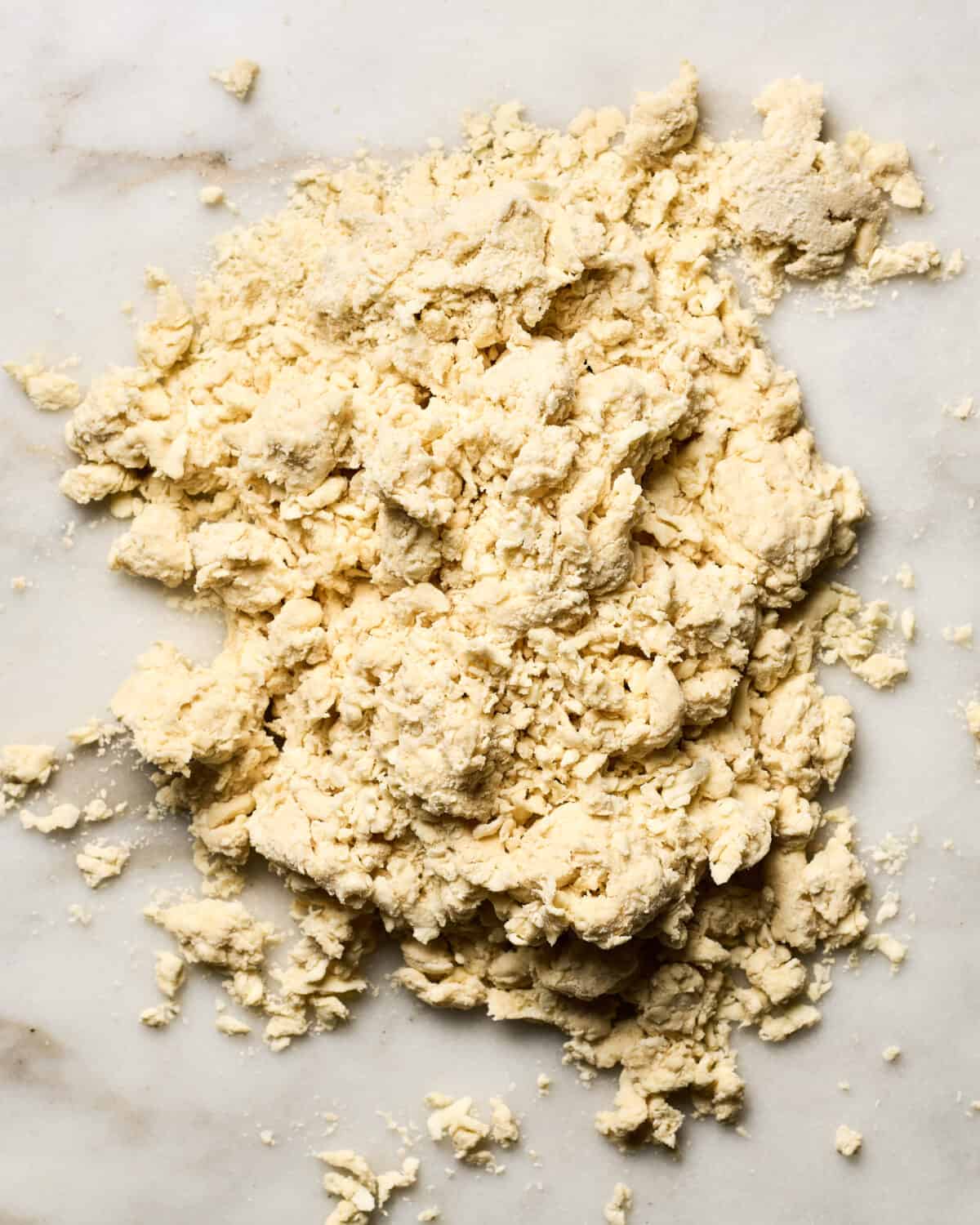
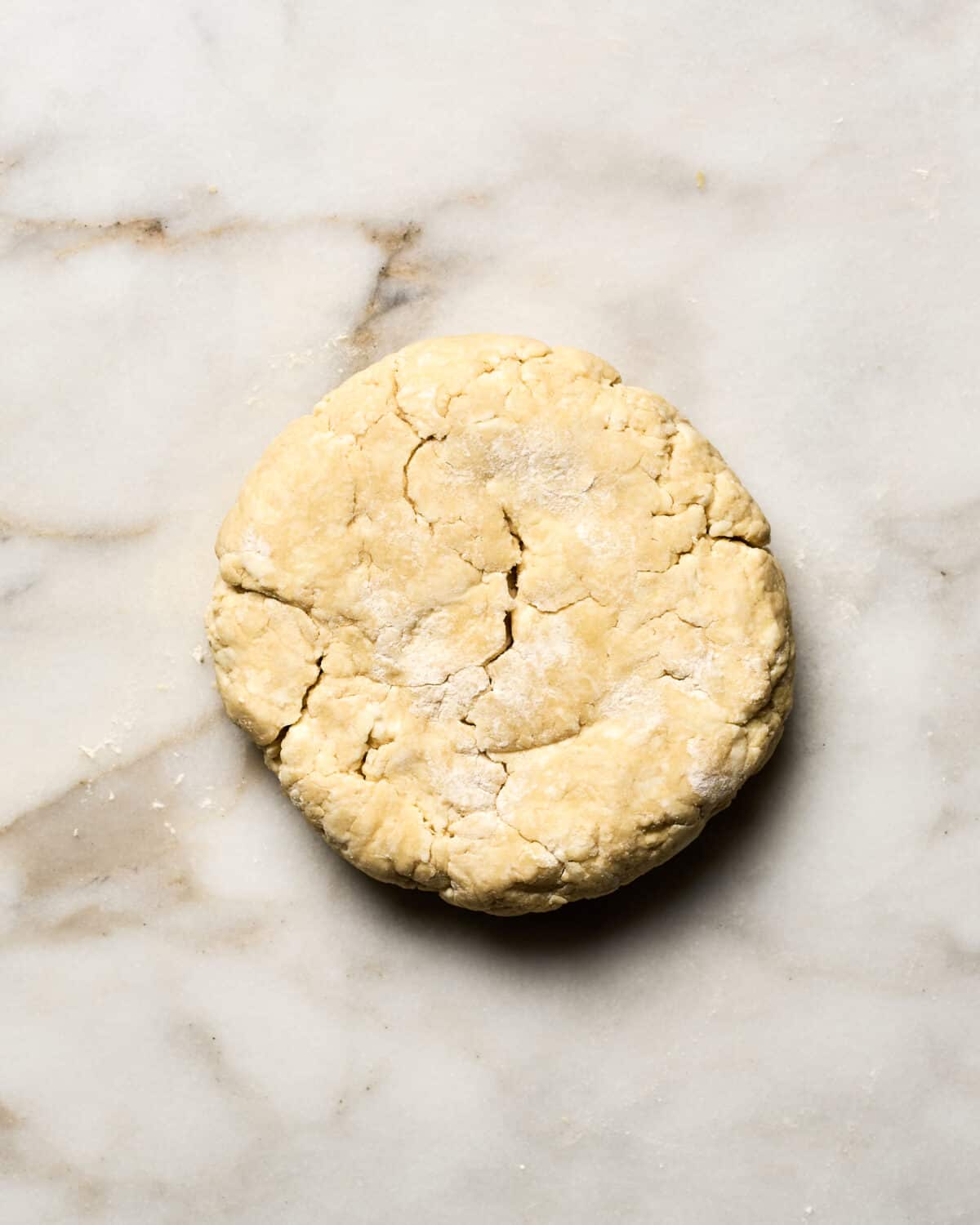
5. Pour the pie crust dough onto your work surface and knead it a few times.
6. Form it into a disc.
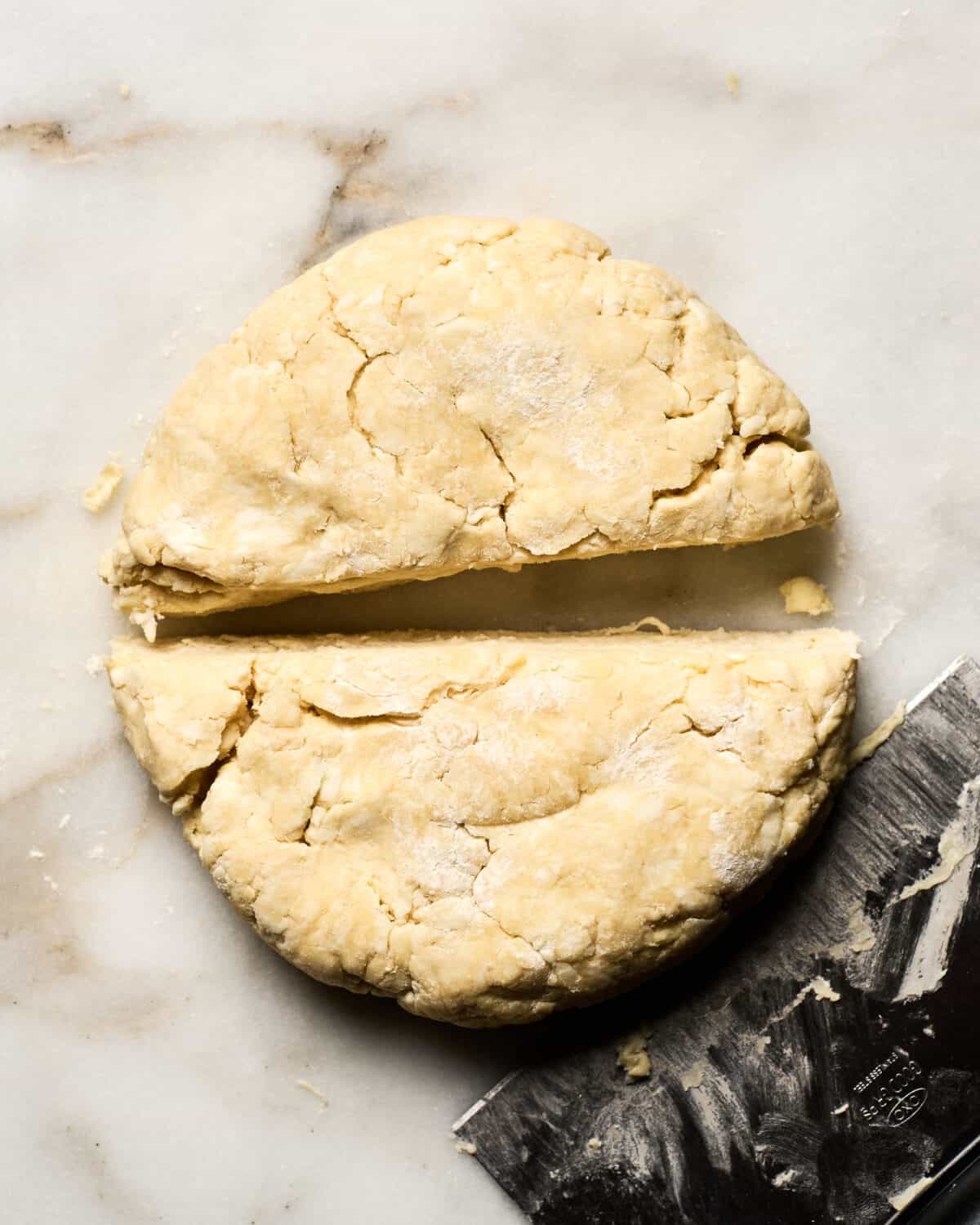
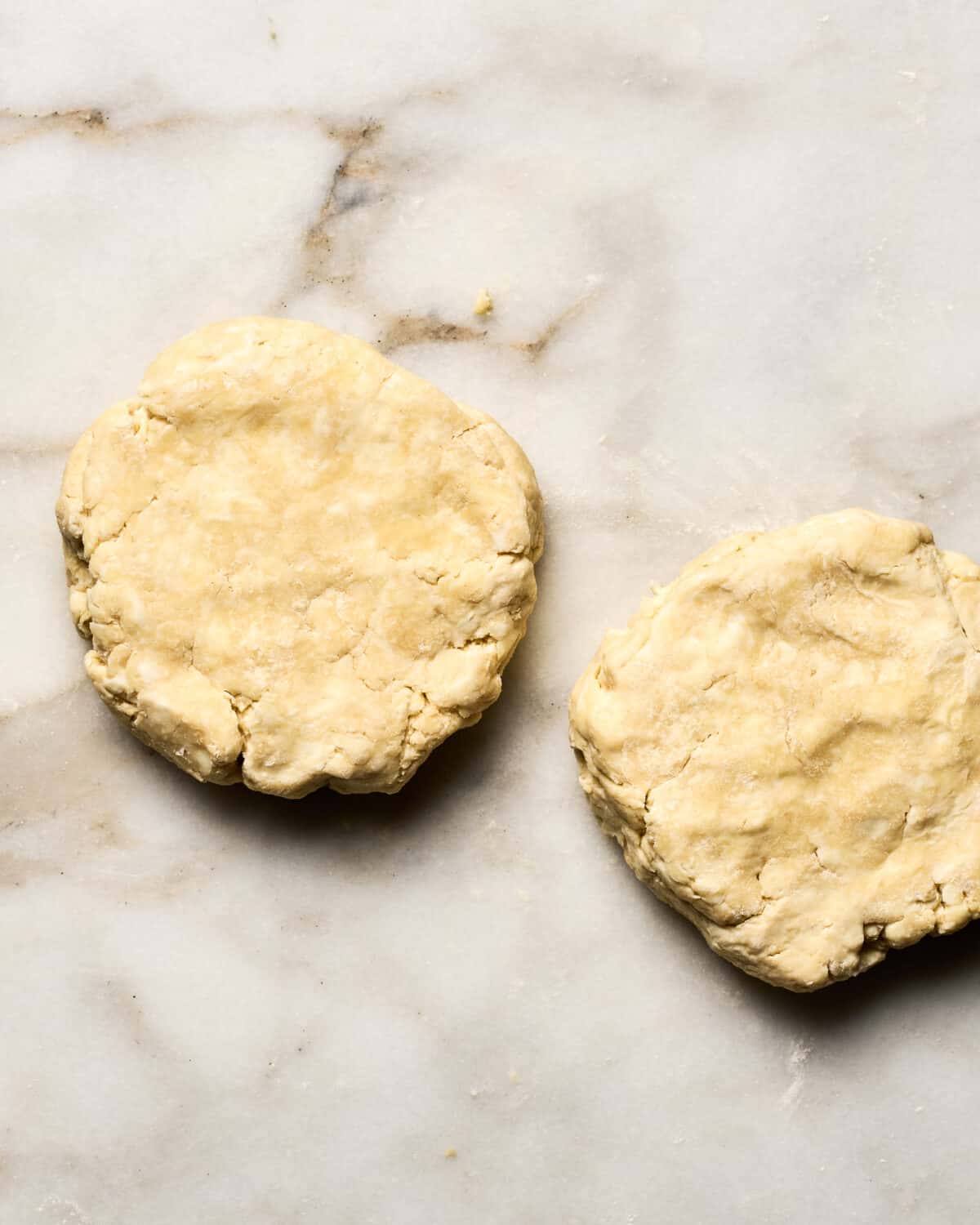
7. Cut it in half.
8. Form two discs. And wrap them in plastic wrap.
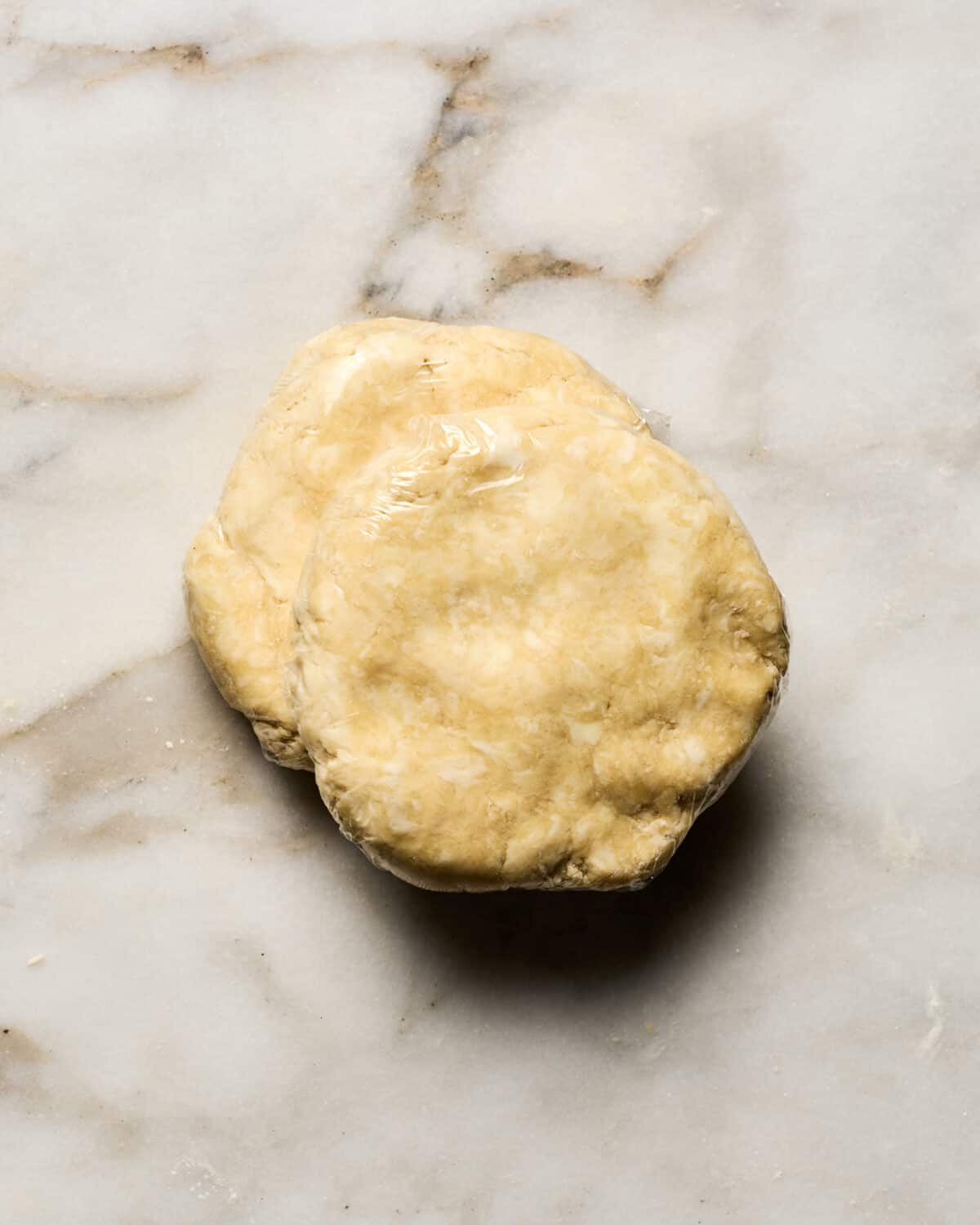
9. Let them rest in the fridge for at least 2 hours, but ideally overnight. Resting them in the fridge allows the gluten to settle and the moisture to despurse evenly throughout the pie crust.
Pie Crust Tips
Weigh your flour. I always weigh out my dry ingredients (because I actually find it easier than dirtying up cup measures). If you do use cup measures, make sure to fluff the flour, scoop it and then level it off with a butter knife.
Everything should be cold! I like to use cold butter straight from the fridge. And I’ll usually drop a few ice cubes into the water so the water is chilly.
Go slowly with the water. I usually add about 50% of the water I need to the dry ingredients, mix it together, AND then add more water a tablespoon at a time, until the dough comes together.
If the disc is a bit shaggy, no biggie. If it’s a bit shaggy, no biggie. When the dough rests in the fridge, the moisture will disburse throughout.
How to Roll out Pie Crust
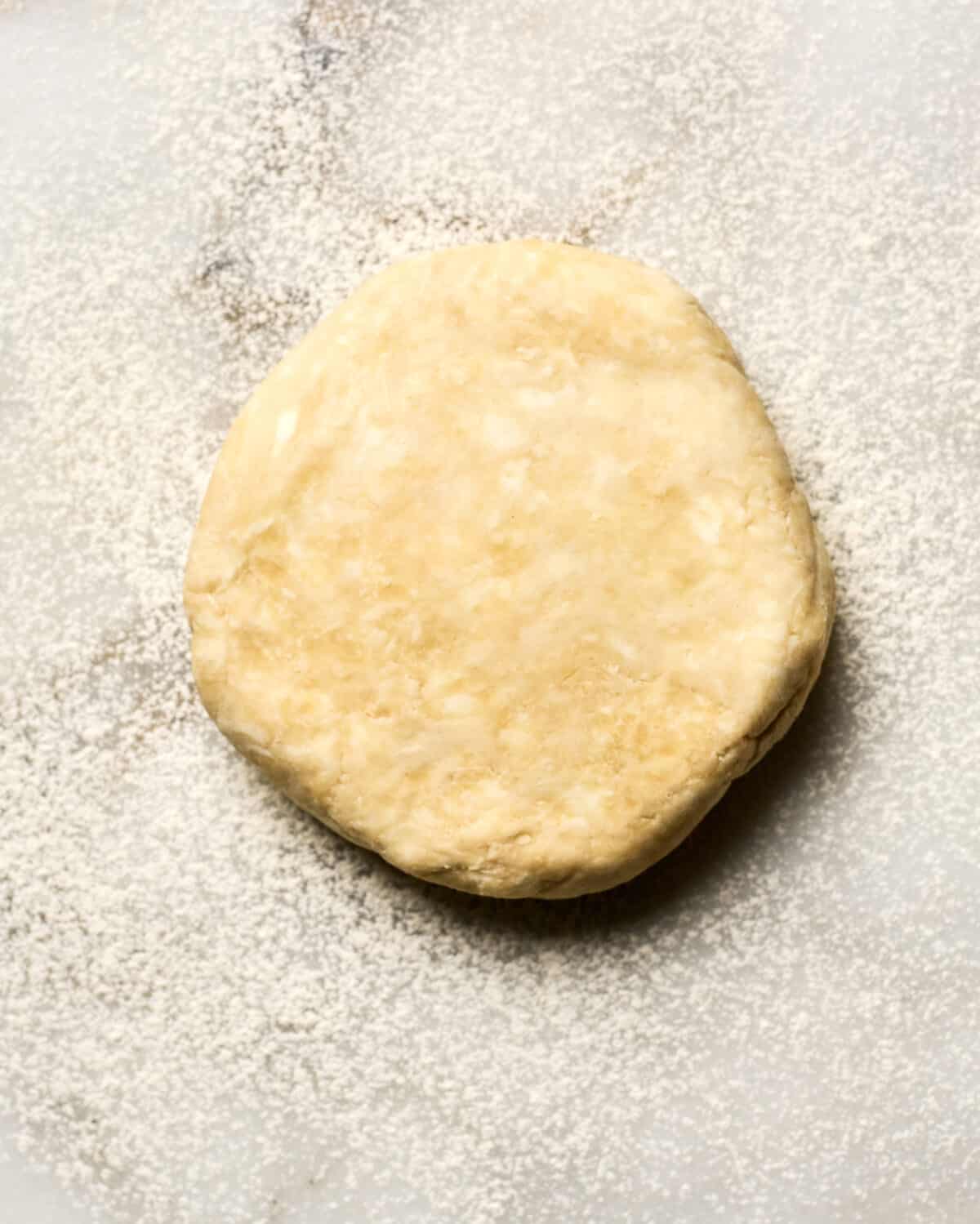
- Remove the disc from the fridge. If it’s been in there overnight, let it rest on the counter for 5 minutes to shake off its chill.
- Flour your work surface lightly with flour. Also flour your rolling pin and the top of the pie crust. Not too much flour!
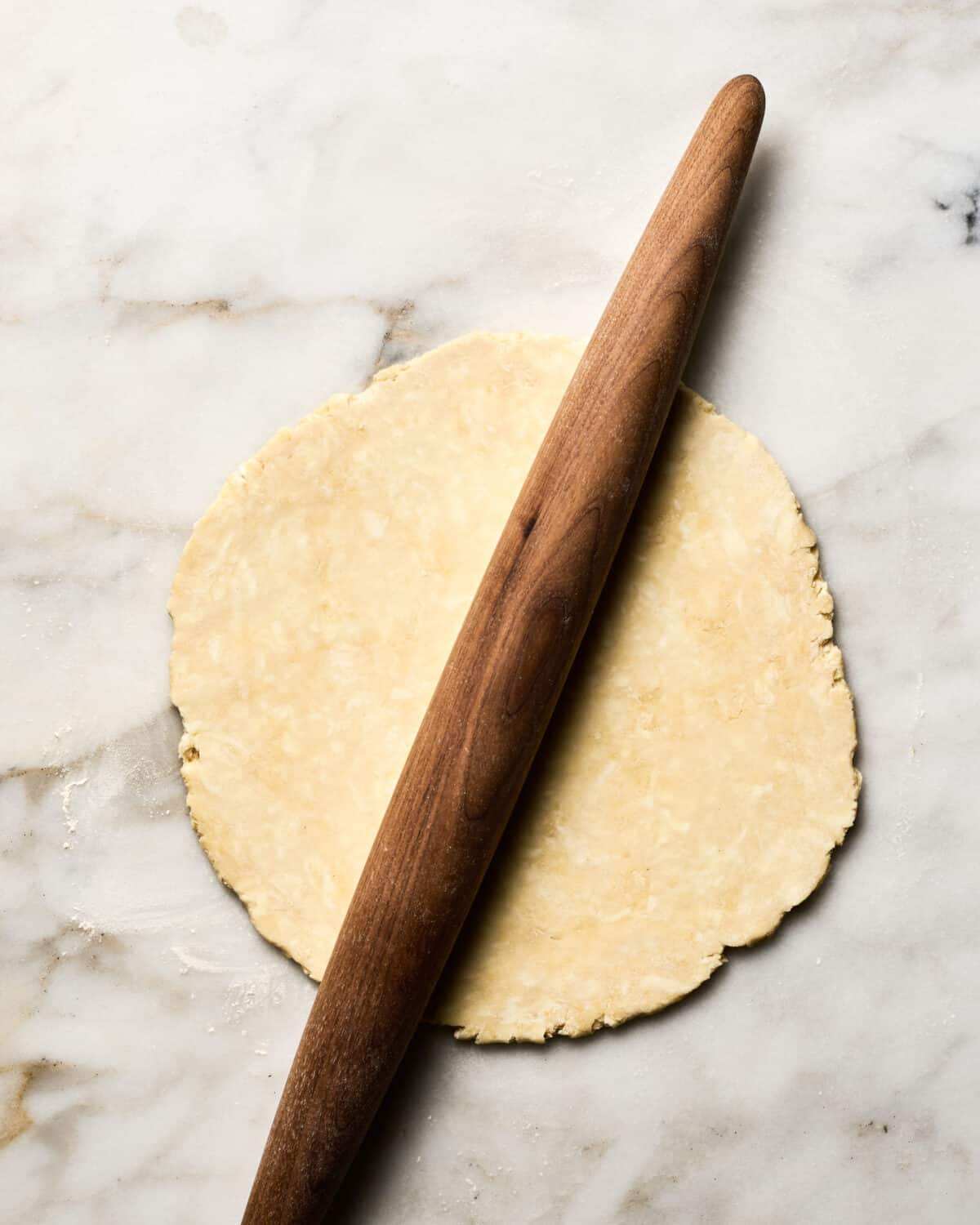
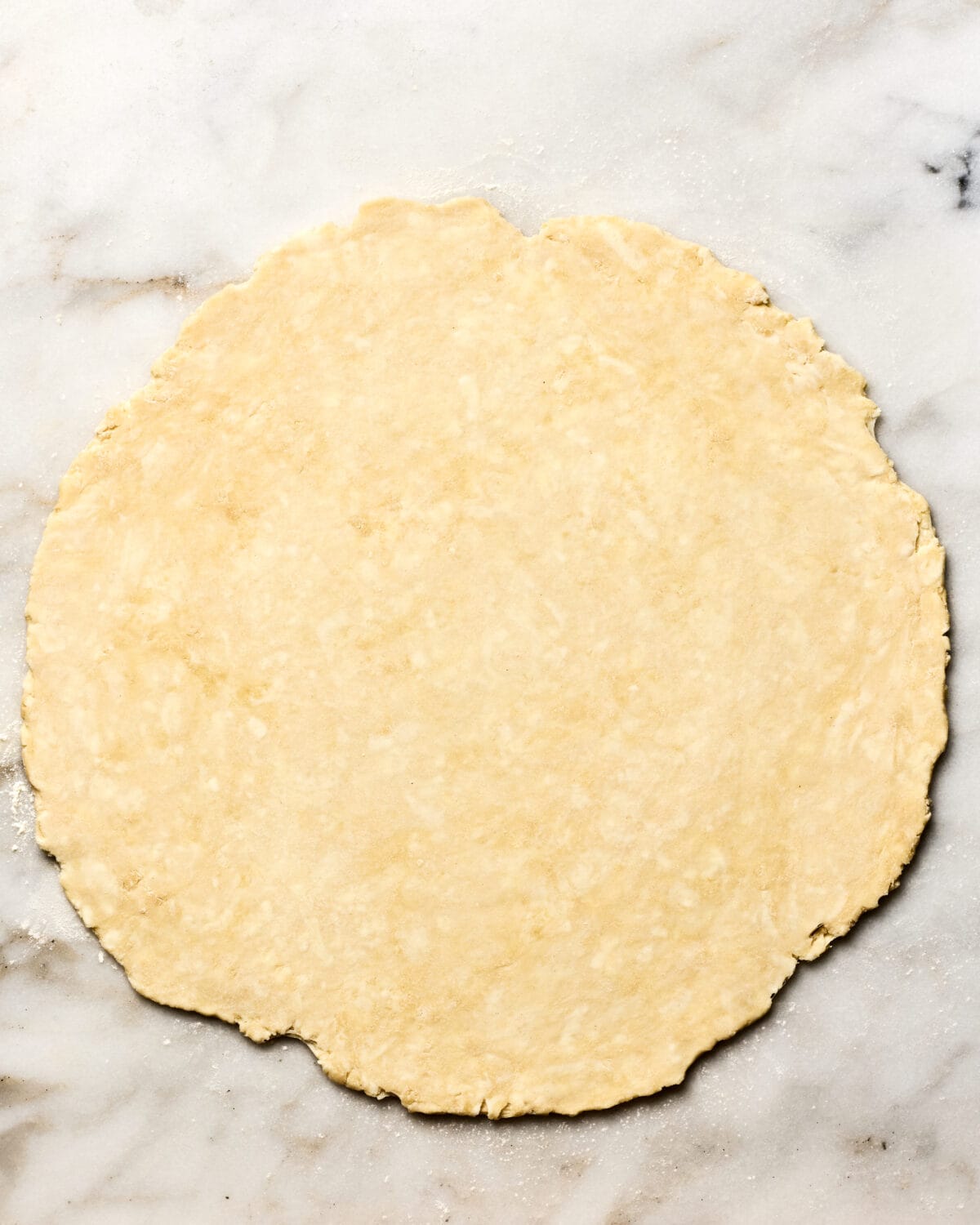
3. Start rolling it out, rotating it every so often. I also like to make sure it’s not sticking to the work surface.
4. Rotate it and roll it some more. Continue this pattern until it’s about 13-inch in diameter.
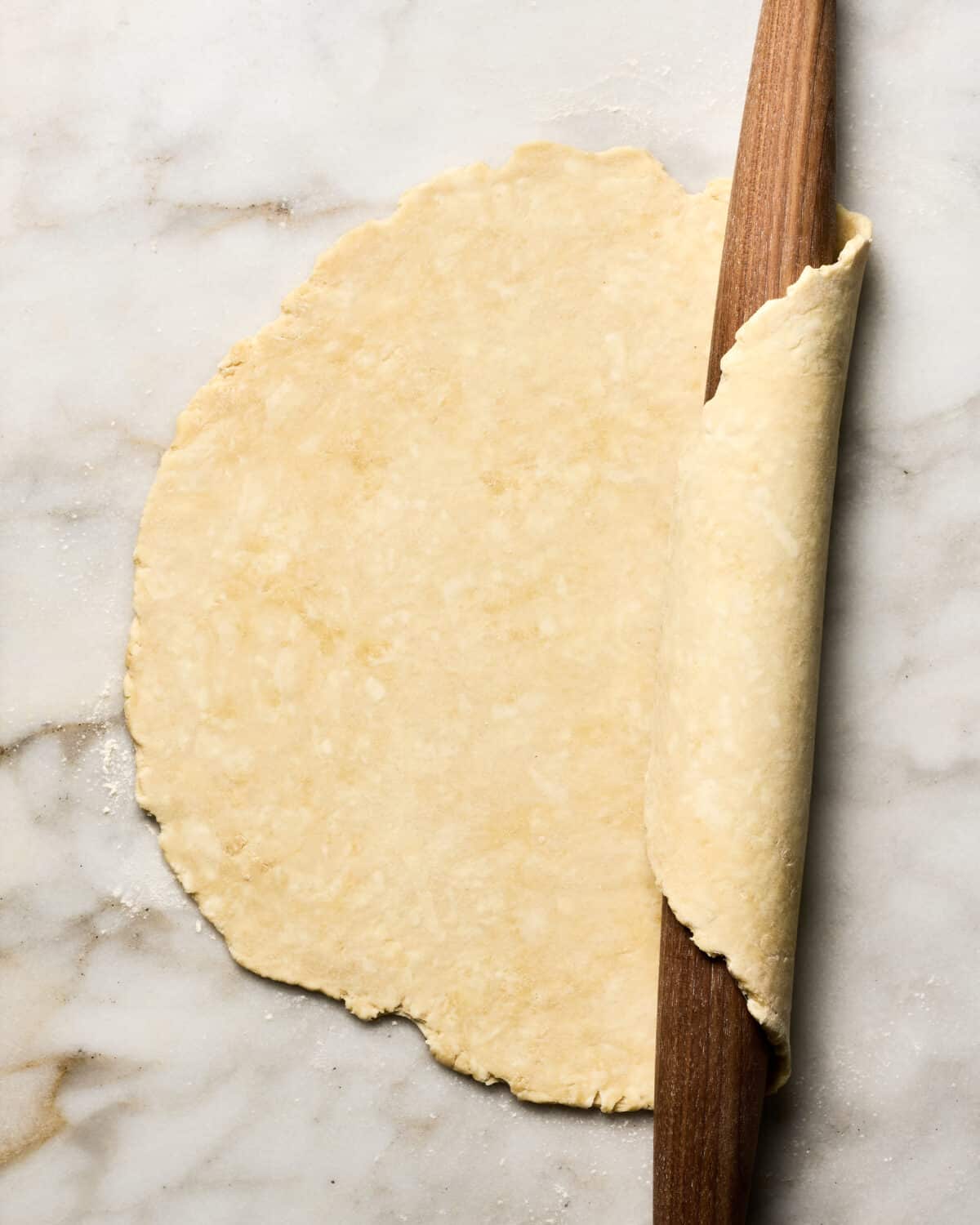
5. Roll it around the rolling pin. I find this as an easy way to transfer it to the pie pan.
Tips on Rolling out the Pie Crust
- Rest the dough. I like to make my pie crust the night before. This does two things: it helps the gluten relax, which will in turn make it easier to roll out. And it helps the moisture evenly disperse throughout the pie crust.
- Cracking Pie Dough. Have you ever started rolling, only to find out the pie dough starts to crack on you?! Very frustrating. Allow the dough to sit on a floured work surface for about 10 minutes. This way it’ll shake off its chill, making it easier to roll out.
- Lightly Flour Everything. Press your rolling pin and roll outward. Give it one push, then rotate the disc a quarter turn, and repeat the process until the pie dough has reached about a 13-inch circle. Keep flouring, too. If the dough seems like it’s sticking to your counter, lift it and sprinkle a little flour underneath.
- Avoid Shrinkage. This happens for two reasons: the gluten has not fully relaxed (hence why I like to keep it in the fridge overnight) or there was too much water in the pie crust. Some shrinkage is normal.
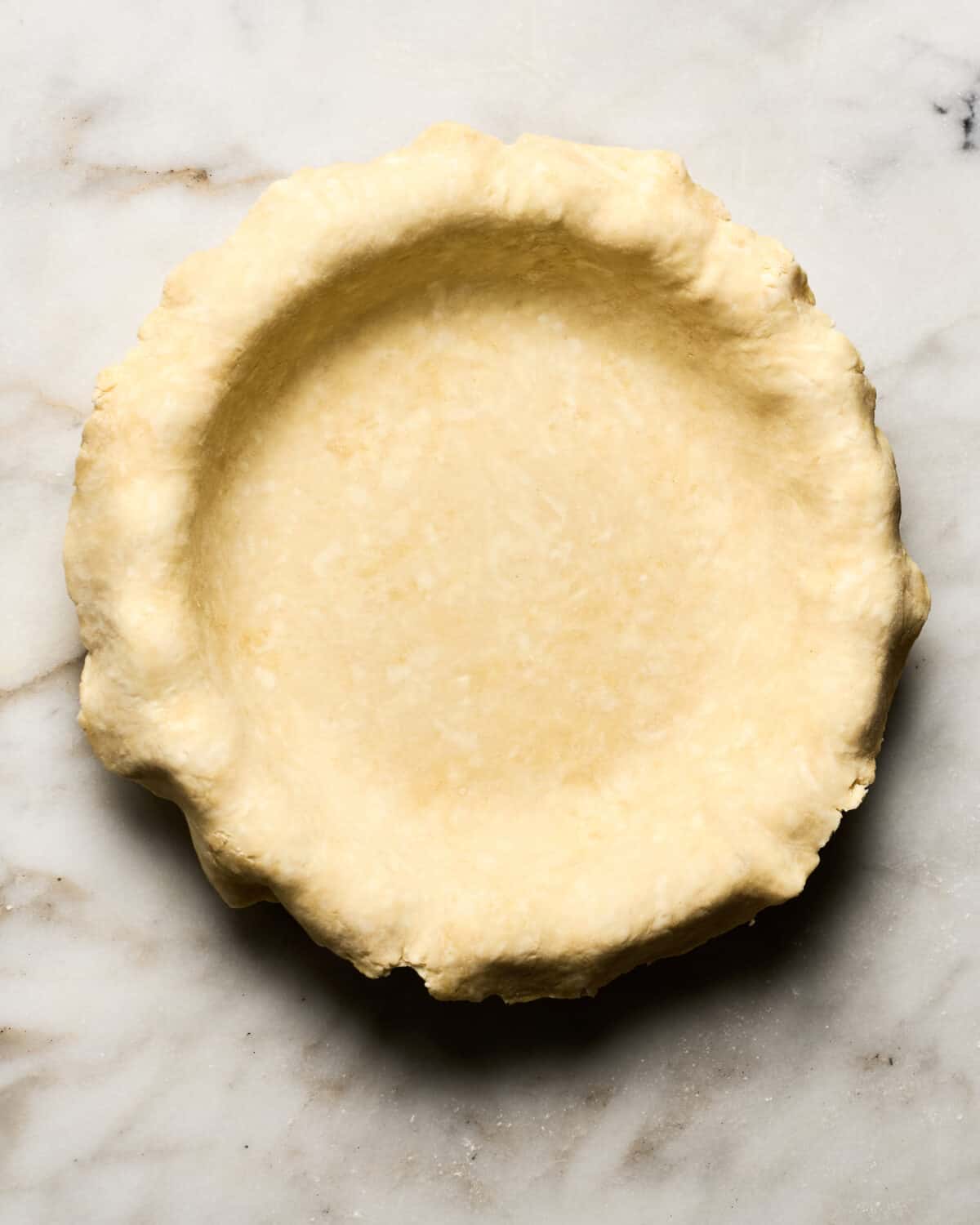
6. You have lots of options at this step.
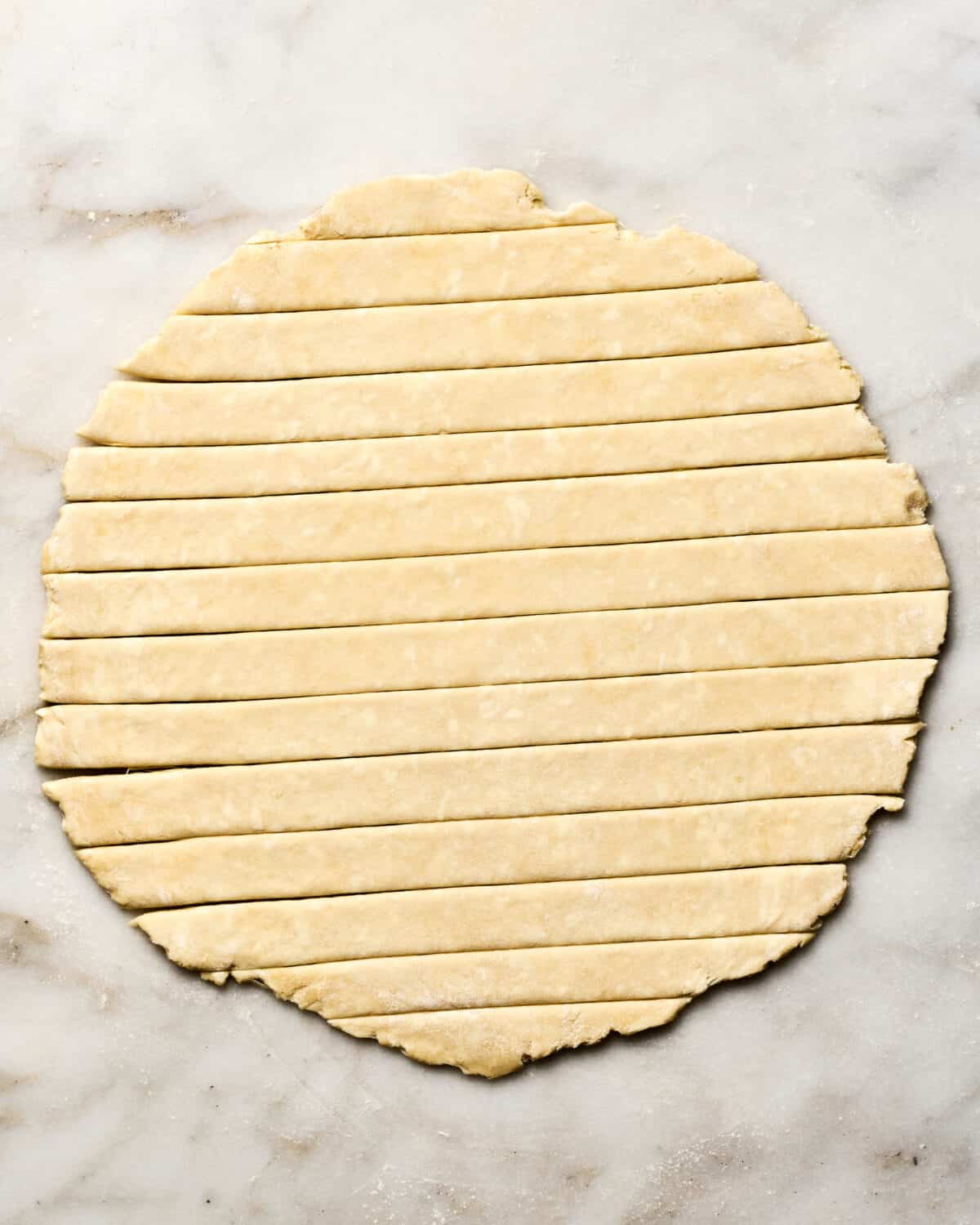
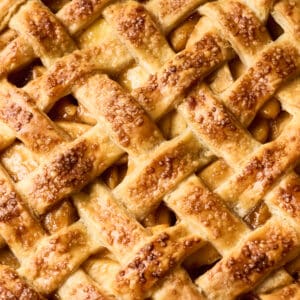
- Roll out the second disc and cut into strips to make a lattice top.
- If you only need a single pie crust, feel free to put the second disc in the freezer for later use.
Recipe FAQs
Absolutely. Store it in the fridge for up to three days. Alternatively, you can place it in the freezer for up to three months. I like to wrap the dough in plastic wrap AND then wrap it in foil to prevent any freezer smells from entering.
Spray a the bottom side of foil with cooking spray. Nestle into the pie crust and then pour either dried beans, rice or pie weights into the piece of foil. Preheat your oven to 400F. Bake for 15 minutes, until mostly golden brown. Remove the piece of foil with the pie weights. Bake for an additional 5 minutes. 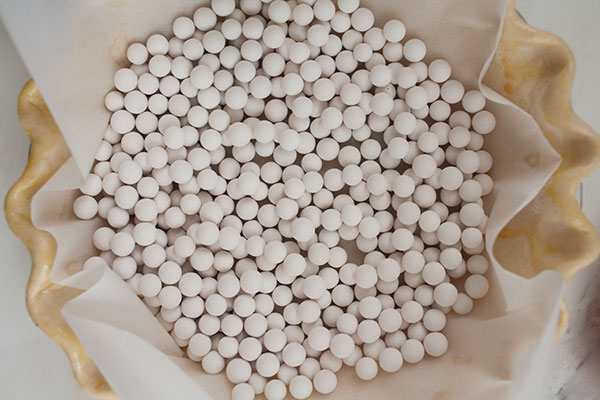
My Favorite Supplies for Homemade Pie Crust
- French rolling pin. These are inexpensive, better looking (in my opinion) and way less heavy than the traditional ol’ handle rolling pins.
- Box grater. See above for my long-winded, very passionate reason why I use a box grater! Another thing that would work is a food processor with the cheese grater attachment. But do we really want to clean a food processor? Not really.
More Pie Recipes
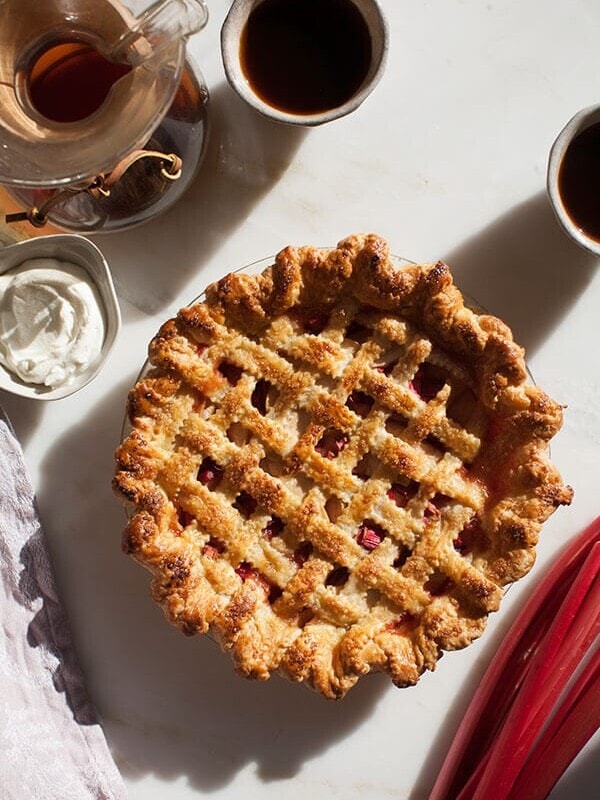
Desserts
Rhubarb Apple Pie
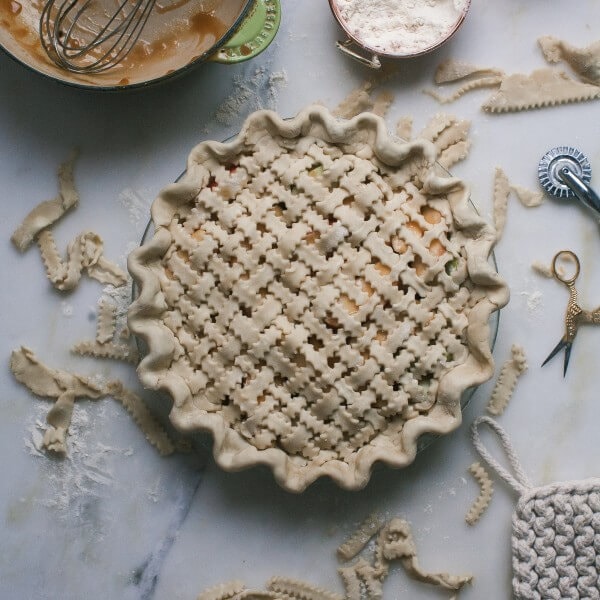
Desserts
Miso Caramel Apple Pie
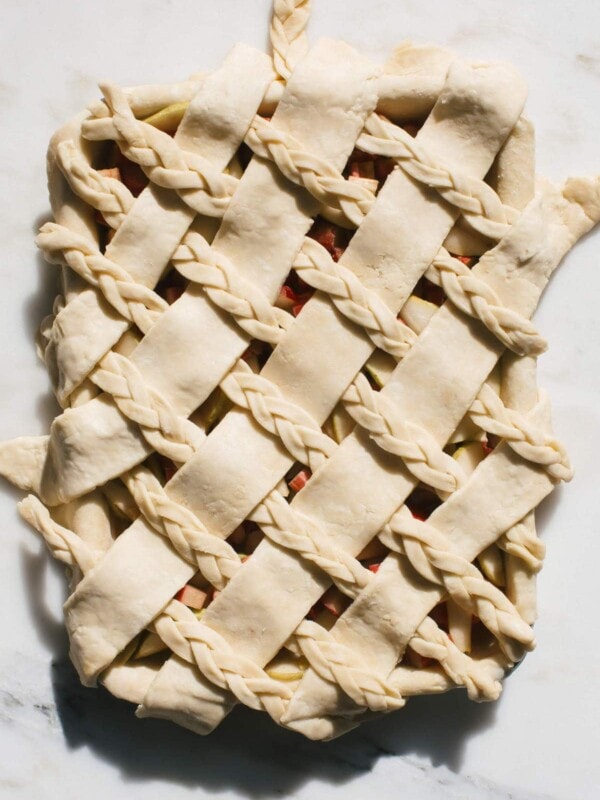
Desserts
Rhubarb Slab Pie
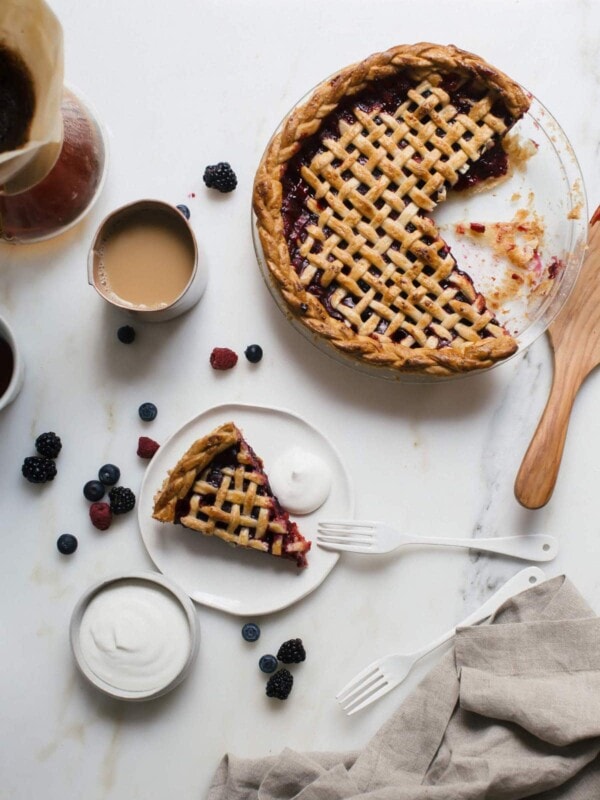
Desserts
Mixed Berry Pie
If you tried this Homemade Pie Crust Recipe or any other recipe on my website, please leave a 🌟 star rating and let me know how it went in the 📝 comments below. Thanks for visiting!
Homemade Pie Crust
Equipment
- 1 (9-inch) pie plate
- 1 box grater
- 1 Rolling Pin
Ingredients
- 2 1/2 (312) cups/grams all-purpose flour
- 2 (28g) tablespoons white granulated sugar
- 1 1/2 teaspoon kosher salt
- 1 (226g) cup unsalted butter, cold, straight from the fridge
- 3/4 cups very cold water, divided
- 1 large egg, beaten (for egg wash)
- 1 tablespoon demarara sugar , for topping
Instructions
To Mix the Dough:
- In a large bowl, mix together the flour, sugar and salt. Using a box grater, grate the cold butter atop the flour mixture. Transfer to the freezer to chill for 10 minutes. Working quickly, and using your hands, break the butter bits into the flour until they’re evenly distributed and resemble the size of teeny, small peas. Add a 50% of the recommended water and mix.
- The mixture will be shaggy at this point. From here, add about 1/4 cup of water and mix. Add an additional tablespoon of water at a time until the dough comes together. (I used all of the 3/4 of water but you may not need to.)
- Flour your counter and dump the dough onto it. Knead a few times more until it comes together into one cohesive mass. Divide the dough into two and wrap each disc in plastic wrap for at least 1 hour, ideally overnight.
- Remove the first disc of dough from the refrigerator and allow to come to room temperature for 10 minutes. Liberally flour your work surface and rolling pin. Begin to roll the dough, being sure to rotate it every so often to avoid sticking, to a 13-inch round. Wrap the dough around the rolling pin and unroll it over the pie tin. Gently fit the dough into the bottom and up the sides of the pie tin. Trim the dough around the pie tin, leaving a 1-inch overhang. Add your filling and transfer the pie to freezer while you roll out the second disc of dough.
- Remove the second disc of dough from the refrigerator and repeat the rolling process as you did with the first disc. You have a couple of options, you could simply lay the second rolled out sheet of dough on top, making a few slits with a knife so steam can escape. You can do a lattice. You could even punch out holes or any sort of shape and place it on top. Crimp the edges and brush with the egg wash.
Notes
- Weigh your flour. I always weigh out my dry ingredients (because I actually find it easier than dirtying up cup measures). If you do use cup measures, make sure to fluff the flour, scoop it and then level it off with a butter knife.
- Everything should be cold! I like to use cold butter straight from the fridge. And I’ll usually drop a few ice cubes into the water so the water is chilly.
- Go slowly with the water. I usually add about 50% of the water I need to the dry ingredients, mix it together, AND then add more water a tablespoon at a time, until the dough comes together.
- If the disc is a bit shaggy, no biggie. If it’s a bit shaggy, no biggie. When the dough rests in the fridge, the moisture will disburse throughout.
Nutrition
Nutrition information is automatically calculated, so should only be used as an approximation.








Oops! Sorry, my mistake! It does!
Thanks for the recipe! Trying it today! Btw, shouldn’t the recipe for single crust use half the butter as double crust? Typo?
I rolled the pie crust out this morning and for the first time ever — no tears, rolled out perfectly! This will be my go-to from this point on. I’ll never have pie anxiety again! Thanks!
I just made this and put it in the fridge to rest. But I didn’t catch the typos in the quantity of flour and water in the single pie crust. The single pie crust should have 1 1/4 c. flour and 6 T. of water. Since I used 1 1/2 c. flour as written, I ended up using about 8 or 9 T. of water to get it to come together. Is this going to screw up the pie crust?
My first clue that something was off was when the single pie crust instructions said to add 1/2 c. water and only 4 T. was in the ingredient list.
I don’t want to start over, but should I?
Nooo…it’s absolutely fine. I actually always make my single pie crust with 1 1/2 cups of flour because I find it need more crust to make a good lattice. I use less pie crust for the topping, so that’s why I have a single pie crust as 1 1/2 cups. It’s absolutely fine that you used 8 to 9 tablespoons. I’ll make that change!
I can’t wait to try this! Can the dough be made in advance and sit in the refrigerator for three days? I would like to make the dough tonight (Sunday) and then make the pie Wednesday night before Thanksgiving.
Yes! You can absolutely do this. Just wrap it very tightly in plastic wrap.
Love the tutorial but there still seems to be a problem with the amount of flour in the single pie crust recipe. One half of the flour used in the two crust recipe would be 1 1/4 cups or 156 grams not the 1 1/2 cups and 187 grams that is still shown in the recipe.
I have made homemade crust but this one sounds great. I have a question and I need help every time I make a meringue or custard pie my crust gets wet and soggy. Can you please tell me what am I doing wrong.
Hmm…I’m not sure, are you blind baking first? Perhaps you need to do it for longer? Also, you may want to switch to a graham cracker crust?
Is this for a 10″ or 9″ pie? I looked everywhere and I must be missing this.
Thanks
It’s a 9-inch pie. 🙂
Loved the double crust recipe– was very, very successful with the first few pie crusts. I just tried the single, though, and didn’t have as much luck. Is there a reason that there’s such a higher proportion of flour in the single recipe compared to the double? Not knowing anything about baking, I followed the recipe exactly, but I had lots of trouble with the dough being too dry and cracking, even after letting it sit on the counter before rolling.
Thanks for the great post!
Holy crap. What the heck am I doing. I’m so sorry about that. You’re totally right. It should be just halved. That’s what my intention was: to just do the math for everyone and I did it wrong. AHH! So sorry. Please accept my apologies. Changing it now!
Best pastry recipe ever! Thank you so much!